
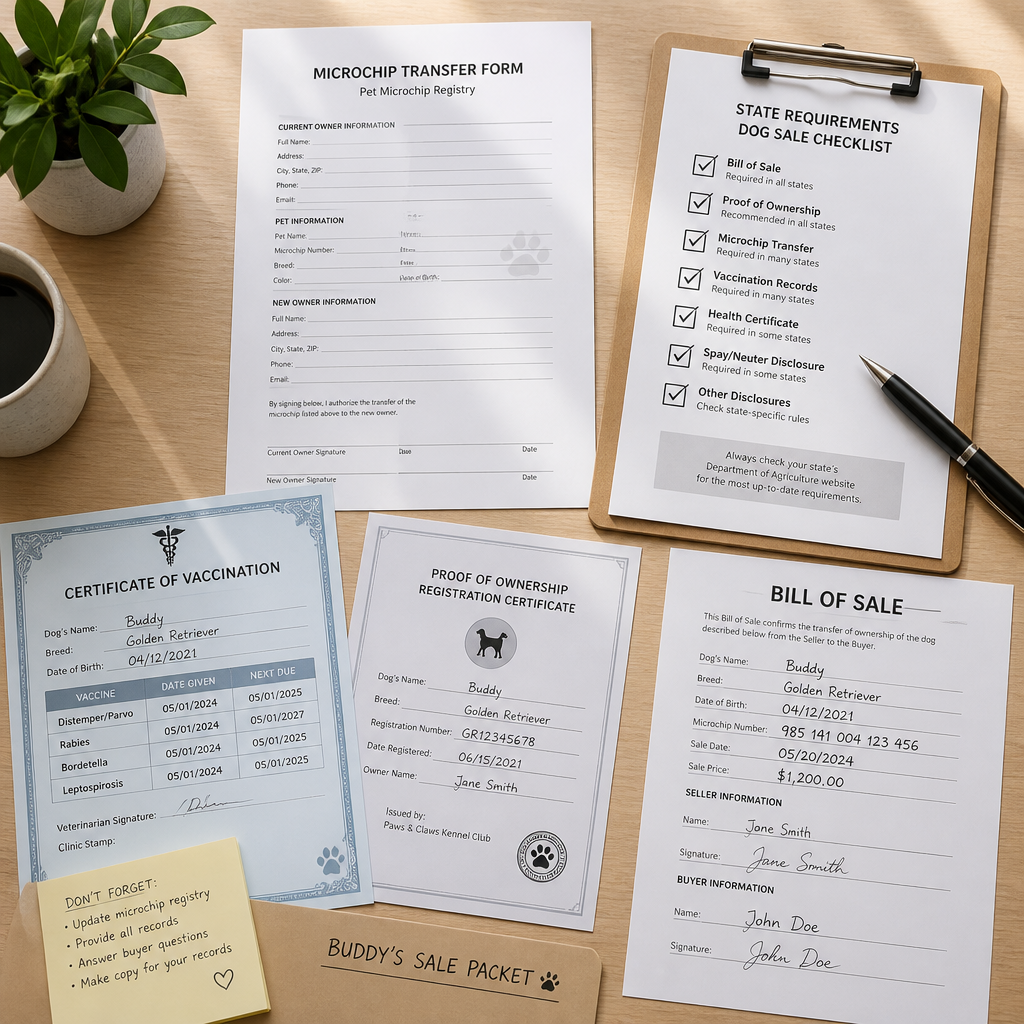
Many dog sellers in Australia list their pet online, accept a deposit, and only then realise they have no idea which paperwork is legally required. That gap is not just stressful, it can expose you to fines, failed sales, and serious legal liability. Whether you are a registered breeder listing on MateLoop, a first-time owner rehoming a beloved pet, or an experienced rescue coordinator, selling a dog documentation Australia rules are stricter than most people expect, and they vary state by state. This guide lays out exactly what you need, why it matters, and what happens if you skip it.
Table of Contents
- Quick Takeaways
- Why Documentation Matters More Than You Think
- Core Documents Every Dog Seller Needs in Australia
- Microchip Registration and Ownership Transfer
- State-by-State Requirements at a Glance
- Pedigree Papers and ANKC Registration
- Advertising Rules You Cannot Ignore
- Frequently Asked Questions
- References
Quick Takeaways
| Key Insight | Explanation |
|---|---|
| Microchipping is mandatory before sale in most states | In NSW, VIC, and QLD, a dog must be microchipped before you legally transfer ownership. No chip means no legal sale. |
| A change of ownership form is not optional | The seller must provide a signed change of ownership form so the buyer can update the microchip registry. Failing to do this leaves you legally on the hook for the dog. |
| VIC and NSW sellers must display a source or breeder number in every ad | Advertising without your Pet Exchange Register source number (VIC) or Breeder Identification Number (NSW) is an offence, not just a guideline. |
| A written sale contract is not legally required but is highly recommended | A signed contract covering health guarantees, return conditions, and payment terms protects both parties and holds up if a dispute goes to a tribunal. |
| Pedigree papers only apply to purebred dogs on ANKC registers | Dogs Australia (ANKC) issues two types: Main Register (blue) and Limited Register (orange). Which one you hand over significantly affects what the buyer can do with the dog. |
| Health and vet certificates add serious buyer confidence | A vet-signed health certificate confirming the dog has been examined and any known conditions disclosed is not required by law in most states but dramatically reduces dispute risk. |
| Desexing certificates affect council registration fees | A desexing certificate means the new owner pays significantly less at council registration. It is worth providing even if not legally mandated at point of sale. |
Why Documentation Matters More Than You Think
Selling a dog without the right paperwork is not just poor form, it creates genuine risk. If ownership is never properly transferred on the microchip registry, you remain the recorded owner. That means if the dog bites someone, gets impounded, or causes a council complaint, the ranger's call comes to you, not the new owner.
Australia's state and territory governments have tightened companion animal legislation significantly over the past decade. Most states now treat an undocumented dog sale the same way they treat an unregistered vehicle transfer: incomplete, legally questionable, and subject to fines. Getting the dog sale paperwork Australia right from the start is not bureaucratic box-ticking, it is basic seller protection.
A common oversight among private sellers is handing over the dog with the microchip still registered in their name. Weeks later, the council contacts them about a nuisance complaint. The fix takes months. Do the transfer correctly on the day of sale, every time.
Core Documents Every Dog Seller Needs in Australia
Regardless of which state you are in, there are several documents that responsible and legally compliant dog sellers should have ready before any money changes hands. Some are mandatory. Others are not legally required but will protect you if the sale ever becomes disputed.
1. Microchip Certificate
This is the document issued when the dog was first microchipped, confirming the chip number and the microchip registry it is recorded on. The seller must provide this to the buyer. Without it, the buyer cannot locate which registry holds the animal's records and cannot complete the ownership transfer. Keep a copy for your own records as well.
2. Signed Change of Ownership Form
This is the most commonly skipped document and the most important one. The seller must sign a change of ownership form (or equivalent notice) so the buyer can update the microchip registry to their own details. In Queensland, for example, a person supplying a dog is legally required to provide a completed and signed change of ownership form to the new owner. The same obligation applies in NSW and Victoria. Without this form, the transfer of registered ownership does not happen automatically just because money was paid.
3. Vet Health Certificate
A health certificate signed by a registered veterinarian confirms that the dog was examined, is in good health at the time of sale, and discloses any known conditions or treatments. This document is not always mandated by law, but it is the clearest way to demonstrate due diligence. If a buyer claims the dog arrived sick and there is no health certificate, your position in any dispute is weak.
4. Vaccination Records
The dog's vaccination history, usually recorded in a vet booklet or printout, should accompany every sale. This tells the buyer what vaccinations have been given, which are due, and confirms that the puppy or dog has received the standard protection against parvo, distemper, and hepatitis. For puppies specifically, vaccination schedules are ongoing, and buyers need to know exactly where the dog is in that schedule.
5. Desexing Certificate (Where Applicable)
If the dog has been desexed, provide the certificate of sterilisation from the vet who performed the procedure. This document affects the buyer's council registration fee in almost every Australian state. A desexed dog costs considerably less to register annually. Withholding this document when you have it is counterproductive and creates unnecessary friction.
6. Sale Contract or Receipt
A written sale contract sets out the agreed price, the condition of the animal at point of sale, any health guarantees, what happens if the dog develops a serious illness within a defined period, and return conditions if the buyer cannot keep the dog. Digital signatures are legally valid in Australia, provided both parties consent and the document is retained as a record. A sale receipt alone is not sufficient if a dispute arises, but it is better than nothing.
Pedigree Papers and ANKC Registration
If you are selling a purebred dog registered with Dogs Australia (formerly ANKC), pedigree papers form a critical part of your documentation. These are issued by internationally recognised canine registries, and Dogs Australia is the only recognised registry of this type in Australia.
Main Register vs. Limited Register
There are two types of pedigree papers in Australia. The Main Register (blue certificate) is required for breeding and conformation showing. If you sell a dog on the Main Register, the buyer can breed that dog, show it in conformation events, and export it from Australia. The Limited Register (orange certificate) restricts the dog from breeding, conformation showing, and export. Handing over the wrong type of papers, or no papers at all, is a common cause of post-sale disputes between breeders and buyers.
What Pedigree Papers Actually Prove
Pedigree papers are essentially a birth certificate showing a three-generation family tree and confirm that the dog is a registered purebred. They verify lineage, support breed integrity, and give buyers eligibility for shows and competitions. For buyers who specifically paid for a purebred dog, receiving no pedigree papers raises legitimate questions about what they actually bought. Dogs Australia Certified Pedigrees are also recognised by state governments and local councils for the purpose of cheaper registration fees and desexing exemptions.
When You Cannot Find the Papers
Lost pedigree papers can be replaced. Dogs Victoria, for example, allows the current registered owner to apply for a duplicate certificate by completing a statutory declaration. The original signed form must be submitted in person, not emailed. If you are buying a dog whose seller claims the papers are lost, verify this through the relevant state canine body before proceeding.
Advertising Rules You Cannot Ignore
Selling a dog is not just about what you hand over at the point of sale. What you put in your advertisement carries its own legal weight, and this is where many private sellers on social media and marketplace platforms fall foul of the law without realising it.
Victoria: Pet Exchange Register Source Numbers
In Victoria, it is an offence to advertise a dog for sale or to give one away without including the animal's microchip number and your Pet Exchange Register source number in the advertisement. This applies to any person, business, or breeder advertising dogs, cats, puppies, or kittens for sale or rehoming. The source number looks like RB123456 for registered breeders or MB123456 for microbreeders. If you do not have one and are not a registered domestic animal business or volunteer foster carer, you need to self-enrol before you list.
NSW: Breeder Identification Number in Ads
NSW requires your Breeder Identification Number (BIN), available free through the NSW Pet Registry, to appear in any advertisement for the sale of a dog. Members of recognised associations such as Dogs NSW can substitute their association registration number. The microchip number of the individual dog must also be included.
What This Means for Your MateLoop Listing
When you list a dog for sale or rehoming on MateLoop, have these numbers ready before you start the listing process. Uploading your microchip number, source or breeder number, and relevant documentation not only keeps you legally compliant, it signals to buyers that you are a serious, responsible seller. In a marketplace that attracts informed buyers, documentation quality directly affects how quickly and confidently your listing converts.
Buyers on legitimate pet marketplaces are increasingly checking for source numbers, microchip numbers, and vet certificates before they make contact. An ad without these details is a flag that serious buyers will skip.
Frequently Asked Questions
Do I need a breeder licence to sell one litter of puppies in Australia?
It depends on your state. In NSW, VIC, QLD, ACT, and SA, you are legally required to have a state registration or identification number even for small-scale or one-off sales. Western Australia and the Northern Territory do not have the same formal system, but animal welfare requirements still apply. Always check with your local council and state agency before advertising your first litter, even if you only have one dog.
What happens if I sell a dog without transferring the microchip?
You remain the recorded owner on the microchip registry. If the dog is impounded, causes an incident, or is involved in a legal complaint, the registry records point back to you. You may be contacted by councils and held liable for costs. The transfer is your responsibility as the seller to initiate, even if the buyer needs to complete it from their end.
Is a written sale contract legally required when selling a dog in Australia?
No state in Australia legally mandates a written sale contract for private dog sales, but the absence of one is consistently damaging in disputes. Australian Consumer Law applies to commercial sellers and imposes implied guarantees of acceptable quality. A written contract that includes health disclosures, a return policy, and payment terms is the clearest way to define what was agreed and protect yourself from a buyer who later claims the dog was misrepresented.
What documents should I ask for when buying a dog through a marketplace like MateLoop?
At a minimum, ask for the microchip certificate, the signed change of ownership form, vaccination records, and proof of the seller's source or breeder number if they are in a state that requires one. For purebreds, request the pedigree certificate and clarify whether it is a Main or Limited Register document. A vet health certificate is not always available but is worth requesting for puppies, particularly if buying from a seller you have not met before.
Can I sell a dog without a microchip in Australia?
In most states, no. NSW, VIC, and QLD all require a dog to be microchipped before it can legally be sold or transferred. In Queensland, if a buyer receives a puppy that is not yet microchipped, they must have it microchipped before the puppy turns 12 weeks old. Selling a dog that is not microchipped exposes you to fines and potentially voids the sale under companion animal legislation.
Do desexed dogs need a special document at point of sale?
Yes. A certificate of sterilisation, issued by the vet who performed the procedure, should be provided to the buyer. This document commonly includes the dog's microchip number and confirms the date of the procedure. The buyer needs it to access reduced council registration fees for desexed animals, and in some states, the certificate must include the microchip number to be valid for that purpose.
What documents do I need to sell a dog interstate in Australia?
Interstate sales carry additional complexity. The laws of both the seller's and buyer's state may apply. You need all the standard documents plus you should check animal transport welfare requirements and whether the receiving state requires any additional documentation upon arrival. If the buyer is in a state with its own registration database, such as NSW, the new owner will need to register the dog locally after the transfer. Confirming all of this before the dog is transported saves significant hassle post-sale.
Have you recently bought or sold a dog through an Australian marketplace? Share what documentation you found most useful, or what you wish you had known before the sale.
References
- Victoria Agriculture: Pet sale advertisement and microchip certificate requirements
- NSW Office of Local Government: Breeder responsibilities and the NSW Pet Registry
- Queensland Government: Dog breeder registration and supply obligations
- Sprintlaw: Legal guidance on creating a puppy sale contract in Australia
- DogzOnline: Guide to pedigree papers and ANKC registration in Australia
General pet care information for Australia. Always follow your veterinarian’s advice for your individual pet.