
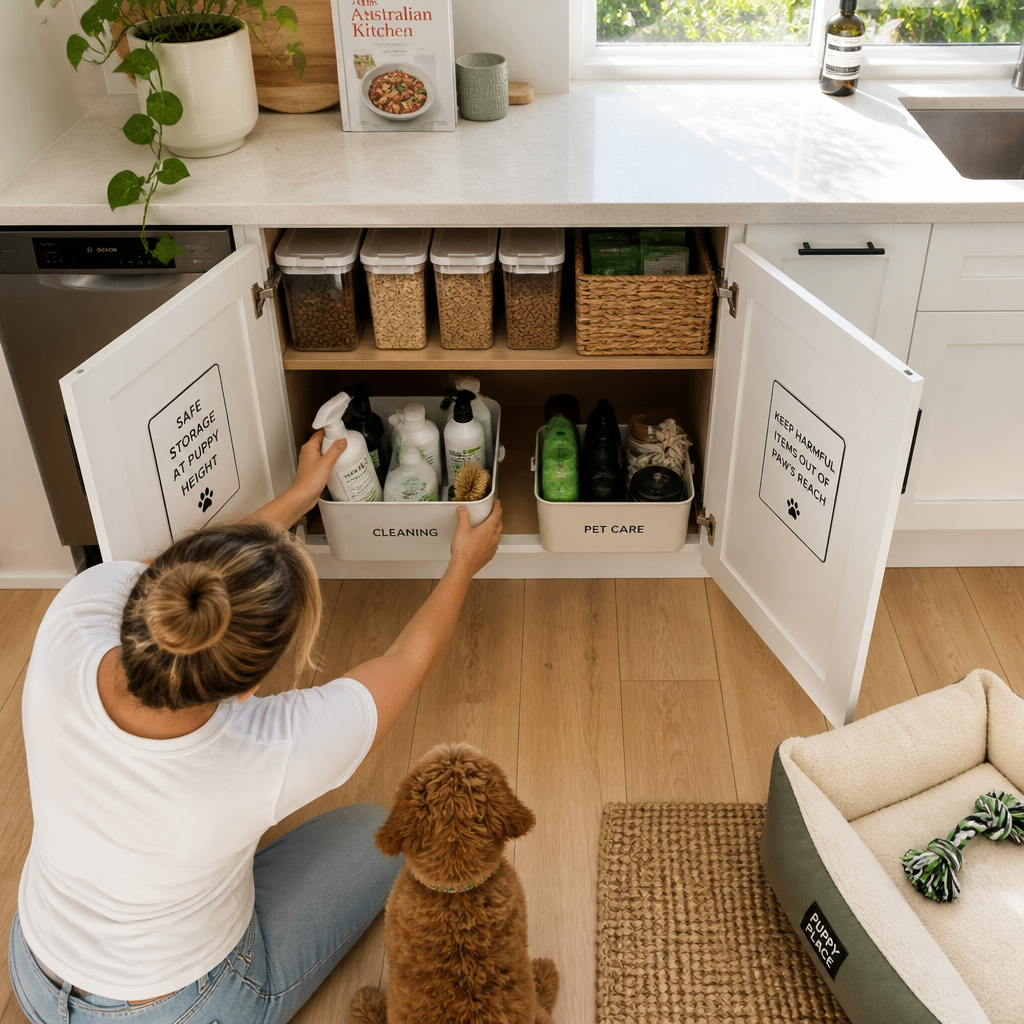
Bringing a new puppy home is one of the most exciting things you can do as a pet owner, and also one of the most hazardous if your house is not ready. Australian homes come with a specific set of risks that catch first-time puppy owners completely off guard: open-plan layouts that are nearly impossible to supervise, backyards stocked with snail bait and pool chemicals, and indoor plants that look harmless but can kill a small dog within hours. Puppy proofing your home in Australia is not about wrapping everything in bubble wrap. It is about walking through your space at puppy height, removing genuine dangers, and setting boundaries that stick. This room-by-room guide will tell you exactly what to look for, fix, and prioritise before your puppy arrives.
Table of Contents
- Quick Takeaways
- Why You Must Puppy-Proof Before Arrival
- Kitchen and Dining Area
- Living Room and Hallways
- Bathroom and Laundry
- Bedrooms and Home Office
- Garage, Backyard, and Pool Areas
- Puppy-Proofing Methods Compared
- New Puppy Checklist: What to Buy Before Day One
- Frequently Asked Questions
- References
Quick Takeaways
| Key Insight | Explanation |
|---|---|
| Start before your puppy arrives | Once the puppy is home you are in reactive mode. Assessing hazards objectively while managing an energetic new arrival is extremely difficult. |
| Get down to puppy height | Walk through each room on your knees. You will spot dangling cords, accessible bins, and chewable furniture legs that are invisible from standing height. |
| Snail bait and rat poison are priority removals | These are among the most common and lethal ingestion risks for dogs in Australian backyards and garages. Remove them entirely, do not just store them "out of reach." |
| Dryer sheets are toxic to dogs | A commonly missed laundry hazard in Australian homes. Even used dryer sheets left on top of machines pose a real risk. |
| Pool access needs a physical barrier | Puppies are naturally curious but are poor swimmers. Pools require a fence or a firm cover, not just supervision. |
| Toxic plants are everywhere in Australian gardens | Lilies, azaleas, and cyclamens are common in Australian homes and gardens and are poisonous to dogs. Audit every plant before your puppy arrives. |
| Gates and playpens beat rules alone | Physical barriers are more reliable than training in the early weeks. Install baby gates on stairs and room entrances as your first line of defence. |
Why You Must Puppy-Proof Before Arrival
Most people think puppy-proofing is something you do in the first week while the puppy is settling in. That is the wrong order. Once your puppy is home, your attention is split between bonding, toilet training, feeding schedules, and keeping the dog out of everything at once. You will not assess your kitchen cabinets calmly while a 10-week-old Border Collie is bolting toward the bin.
The goal of puppy-proofing is to make your home systematically safe, not merely to hide a few things. That means going room by room before the puppy arrives, looking at the space at floor level, and removing hazards you did not even know existed. A safe home for a puppy is not just about locking up chemicals. It is about creating an environment where your puppy can explore without you needing to watch them every second.
A genuinely safe environment for a puppy combines hazard management with routine and structure, because predictability is what keeps a puppy calm and reduces the stress-driven behaviours that lead to accidents and injury.
Designate one safe zone first. This is a gated room, playpen area, or crate corner with the puppy's bed, water, and toys. It becomes their anchor point in the home and gives you a go-to secure space when you cannot supervise directly.
Bathroom and Laundry
These two rooms are often overlooked because they feel clinical and empty. In reality, they contain some of the most concentrated chemical hazards in any home. The simplest rule for both rooms: keep the doors closed when you are not directly supervising.
Bathroom risks
Medications are the highest priority. All medications, including over-the-counter products like paracetamol (which is lethal to dogs even in small doses), ibuprofen, and any prescription drugs, must be stored in a locked cabinet well above floor level. Razors, dental floss, cotton tips, and personal care products should also be out of reach.
Keep toilet lids closed. If you use toilet cleaning tablets or chemical blocks in the cistern or bowl, the water itself becomes a toxic liquid. Puppies will drink from the toilet if they can, and a chemically treated bowl is a direct poisoning risk.
Laundry hazards
Washing detergents, fabric softeners, and bleach-based cleaners should be stored in locked or latched cabinets. One hazard that most Australian puppy owners miss entirely: dryer sheets are toxic to dogs. Even used ones left on top of the dryer or in a low laundry basket are a real risk. Dispose of them in a sealed bin immediately after use.
Keep laundry off the floor. Socks, underwear, and other small clothing items are favourite chew targets and a genuine choking and obstruction hazard. Make a habit of putting laundry directly into a hamper with a lid, not on the floor or on low surfaces.
Bedrooms and Home Office
Bedrooms feel lower-risk because there are no obvious chemicals. The main hazards are small objects, dangling cords (phone chargers, lamp cords, laptop cables), and medications stored on bedside tables. Nightstands are exactly at nose height for many breeds, and a puppy that can reach one will investigate every item on it.
Home office risks
Home offices contain an unusual density of cord hazards. Computer cables, monitor cords, printer cables, and phone chargers all tend to trail across the floor. Run all cables through cable management conduit or clip them to skirting boards and desks. Puppies are especially drawn to thin cables and will chew through a phone charger cable in under a minute.
Paper, pens, paper clips, staples, and rubber bands should be kept in drawers. These are all potential ingestion hazards and very easy to leave scattered across a desk that a puppy will learn to reach by jumping as they grow.
Garage, Backyard, and Pool Areas
The garage and backyard are where the most serious poisoning and injury risks exist for Australian puppies. These areas tend to be treated as storage for items that are either not used often or not considered household items, which means they rarely get audited for pet safety.
Garage chemical hazards
Antifreeze (ethylene glycol) is extremely toxic to dogs and unfortunately smells and tastes appealing to them. Any containers of engine chemicals, automotive fluids, fertilisers, herbicides, or pesticides must be stored in locked cabinets or completely removed. Do not rely on storing these items "out of reach." Many poisoning cases involve containers knocked off shelves or cupboards accidentally left open.
Rat poison ingestion remains one of the most common serious toxicity cases in Australian dogs. Snail bait poisoning is also well documented. If you have either product in your garage or shed, remove them entirely and dispose of them properly. There is no safe version of "we keep it locked up." For a puppy's first year, these products simply should not be on your property.
Fencing and escape routes
Your fence is the first line of defence between your puppy and the street. Test it the way a determined puppy will: check for gaps at ground level, spots where the ground is soft enough to dig under, and any sections that are low enough to be scaled as the puppy grows. This is especially important in Queensland homes with open-plan layouts and sliding doors that create large, hard-to-monitor outdoor spaces.
Check every plant in your garden before your puppy arrives. Lilies, azaleas, cyclamens, and amaryllis are among the most common garden and indoor plants in Australia and all are toxic to dogs. Remove them or fence off access to garden beds entirely during the puppy's early months.
Pool and water safety
Puppies are naturally curious around water but are not natural swimmers, and exhaustion sets in quickly. A pool must have a properly secured fence or firm pool cover, not just a step pool net. Pool chemicals including chlorine tablets and algaecides stored near the pool area also need to be locked away completely.
Pro tip: Do not assume your puppy can find the pool steps and get out safely. Even if they can swim short distances, they can panic, become disoriented, and exhaust themselves before finding an exit. Physical barriers are non-negotiable.
Puppy-Proofing Methods Compared
There are three broad approaches Australian puppy owners use to secure their home. Each has real advantages and limitations, and in practice the best outcome comes from combining all three rather than treating any one as sufficient on its own.
| Method | Best For | Limitations |
|---|---|---|
| Physical barriers (baby gates, playpens, cabinet locks, fencing) | Blocking access to hazardous rooms, stairs, pools, and garden areas. Most reliable for high-risk zones. Works from day one without any training. | Can be bypassed by larger or older dogs. Requires consistent use by every person in the household. Gates left open once can become a habit. |
| Hazard removal (removing toxic products, securing bins, clearing floor items) | Eliminating the source of risk entirely. No ongoing maintenance required once done. Best for chemicals, plants, and small objects. | Requires a thorough one-time audit. Easy to miss items you use regularly (medications, cleaning products, laundry items). Must be repeated after any change to the household. |
| Supervised access and crate training (limiting freedom to one room at a time, crate use when unsupervised) | Building good habits and preventing anxiety-driven destructive behaviour. Essential complement to physical proofing during the first 6-12 months. | Relies entirely on human consistency. Not reliable if family members do not follow the same rules. Cannot substitute for removing actual hazards. |
New Puppy Checklist: What to Buy Before Day One
Getting the physical safety items right before your puppy arrives means you spend day one bonding with your dog, not making emergency hardware store trips. The following checklist covers the core puppy-proofing purchases for an Australian home. Once you have your puppy settled and safe, exploring the full range of supplies, toys, and professional services at MateLoop will give you everything you need to build on a safe foundation.
- Baby gates or puppy gates: At minimum, one for the staircase and one to block access to the kitchen or laundry. Pressure-mounted gates work for most doorways; screw-mounted gates are essential at the top of stairs.
- Puppy playpen or crate: A safe, enclosed space where your puppy can rest and sleep without supervision. Choose a size appropriate for your breed's adult size so you are not replacing it in three months.
- Secure rubbish bin: One with a locking lid or a bin stored inside a latched cabinet. A non-negotiable for kitchen and laundry.
- Cabinet locks: Childproof latches for any under-bench cabinet containing cleaning products, medications, or food items.
- Cord protectors: Flexible cable conduit or cord covers for all exposed electrical cables in living areas and home offices.
- Chew toys: A range of suitable chewing options redirects natural puppy chewing behaviour away from furniture, cables, and footwear.
- Pet-safe cleaning products: Replace standard floor cleaners and sprays with products that do not leave toxic residues on surfaces a puppy will lick and walk on.
If you are still in the process of finding the right puppy, MateLoop's pet marketplace connects you with reputable breeders, rescues, and adoption listings across Australia for dogs, cats, and more. Starting with a trusted source means you also get better information about your specific breed's temperament, energy level, and the particular hazards to look out for in your home.
Budgeting realistically for the initial setup is worth doing before you bring a puppy home. Core puppy-proofing supplies (gates, crate, cabinet locks, cord protectors, a secure bin) represent genuine safety spending, not optional extras. They are significantly less expensive than a single veterinary emergency visit for an ingestion incident.
Frequently Asked Questions
At what age can I stop worrying about puppy-proofing my home?
There is no single age, as it depends on your dog's breed, size, and individual temperament. Most dogs settle significantly between 12 and 18 months as they move out of the peak chewing and exploratory phase. That said, some high-energy breeds remain destructive and investigative well into their second year. A practical approach is to maintain physical barriers and secured storage until your dog has shown consistent reliable behaviour for at least three months without incidents.
What are the most dangerous household items for puppies in Australia?
The most dangerous items are rat and snail bait (extremely common in Australian backyards), human medications left accessible, antifreeze and engine chemicals in garages, certain houseplants and garden plants (lilies, azaleas, cyclamens), and small ingestible objects like coins, rubber bands, and children's toy parts. The kitchen rubbish bin is also a consistent hazard because it combines multiple risks including toxic foods, cooked bones, and packaging materials.
Can I use baby gates designed for children to puppy-proof my home?
Yes, most standard baby gates work well for small to medium breeds during the early months. For larger breeds, check the gate's rated height and ensure the bar spacing is narrow enough that a puppy cannot squeeze through or get their head stuck. Screw-mounted gates are significantly sturdier than pressure-mounted ones and are the right choice for the top of any staircase. Pressure-mounted gates are fine for blocking doorways between rooms.
Which Australian garden plants are toxic to dogs?
Lilies (both Daylily and True Lily species), azaleas, cyclamens, and amaryllis are among the most commonly found toxic plants in Australian homes and gardens. These plants can cause symptoms ranging from vomiting and diarrhoea through to heart abnormalities, seizures, and in serious cases death. Always check whether a plant is dog-safe before purchasing it, and audit every existing plant in your garden before your puppy arrives. If in doubt, contact your vet or the Animal Poisons Helpline Australia.
Is it safe to let my puppy in the backyard straight away?
Only if the backyard has been fully audited and physically secured. That means checking the fence for gaps, low points, and dig-out spots; removing all toxic plants and chemicals; securing the pool with a proper barrier; and ensuring there is no rat bait, snail bait, or fertiliser accessible. If your yard is not yet fully secured, use a puppy playpen outside to give your dog fresh air and outdoor time without the risk of escape or ingestion incidents. Letting a puppy into an unsecured backyard unsupervised is one of the most common ways Australian puppies are lost or injured.
Do I need to puppy-proof rooms my puppy will not have access to?
Yes, and here is why: barriers fail. Gates are accidentally left open, doors do not latch properly, and a determined puppy will eventually find a way into a room they have noticed humans entering. If a room contains medications, chemicals, or valuable items, treat it as accessible and secure it accordingly. The 10 minutes it takes to childproof a spare bedroom cabinet could prevent an emergency vet visit.
Share your puppy-proofing experience in the comments below. What hazard did you discover that genuinely surprised you?
References
- Room-by-room puppy-proofing safety checklist with Australian-specific hazard guidance
- Puppy-proofing guide covering indoor and outdoor hazards for Australian homes
- Veterinary advice on puppy-proofing including fencing, rat poison, and common toxins
- New puppy checklist for Australia covering setup costs and safe introduction to the home
- Practical puppy-proofing tips for every room including backyard and bathroom safety
General pet care information for Australia. Always follow your veterinarian’s advice for your individual pet.