
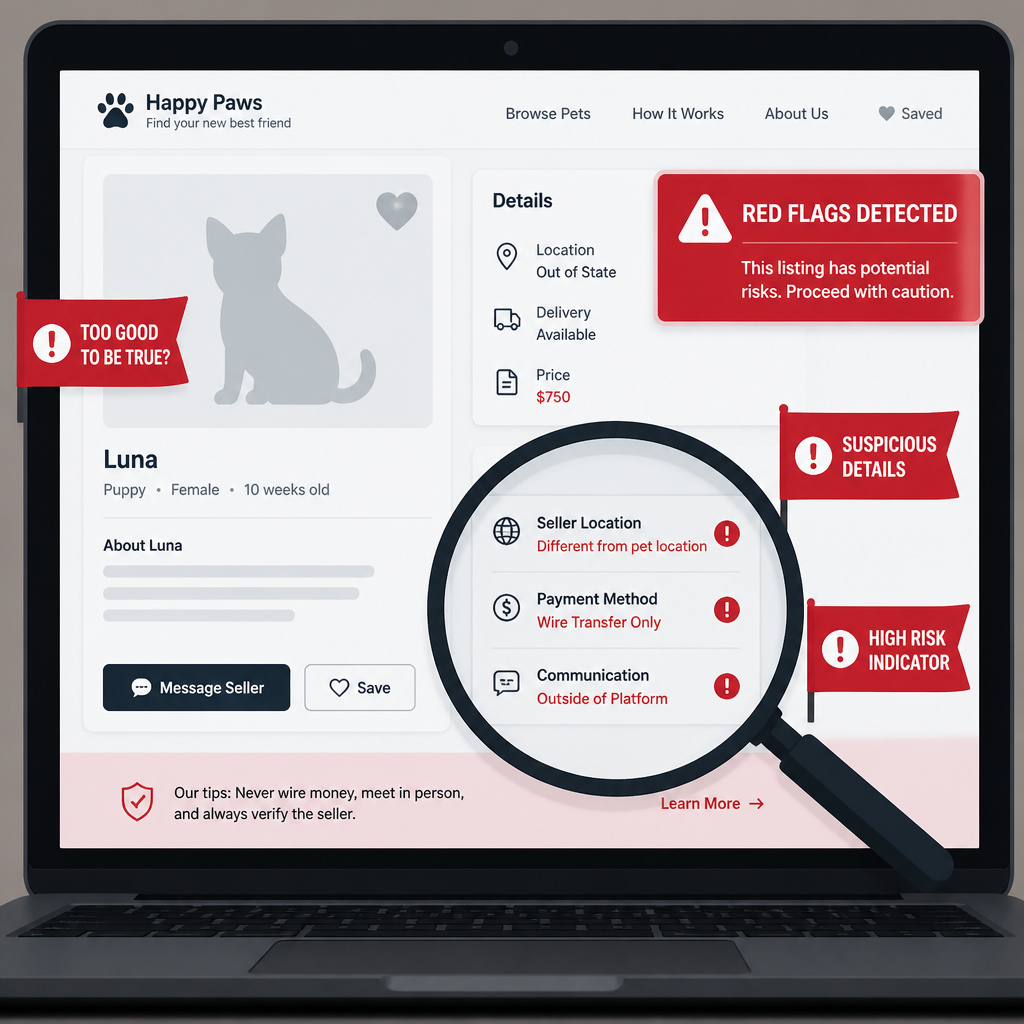
Australians have lost millions of dollars to pet scams, and the numbers keep climbing. According to the ACCC, Australians lost $4.2 million to puppy scams in 2021 alone, a staggering increase of over 1,000% since 2019. Cavoodles, poodle-crosses, and Maine Coon kittens are among the breeds most frequently used in fake listings. If you are searching for a dog, cat, or any other pet online, understanding the anatomy of a pet scam Australia can save you thousands of dollars and a world of heartbreak. This guide breaks down every major warning sign, verification step, and safe-buying practice you need before handing over a single cent.
Table of Contents
- Quick Takeaways
- How Pet Scams Work in Australia
- Red Flags in Pet Listings You Should Never Ignore
- How to Verify a Pet Seller Before You Pay
- Safe Payment Methods and Which to Avoid
- Comparing Pet Buying Platforms: Safety Features Side by Side
- What to Do If You Have Been Scammed
- Frequently Asked Questions
- References
Quick Takeaways
| Key Insight | Explanation |
|---|---|
| Scams follow a two-stage pattern | Scammers first build trust with stolen photos and scripted messages, then demand deposits or escalating fees once you are emotionally invested. |
| Cavoodles and poodle-cross breeds are most commonly faked | These are high-demand, high-price breeds. Scammers use them specifically because buyers are willing to pay more and act faster out of fear of missing out. |
| Reverse image search is your single best free tool | Most scam listings use photos stolen from legitimate breeders. Running the listing photos through Google Lens or TinEye often uncovers the original source immediately. |
| No in-person meeting is a hard dealbreaker | Any seller who refuses to meet face-to-face, or who has an elaborate reason why you cannot visit, is almost certainly running a scam. |
| Wire transfers and gift cards mean no recourse | Once money is sent via wire transfer, gift cards, or cryptocurrency, it cannot be recovered. Scammers demand these specifically because they are untraceable and irreversible. |
| Newly registered websites are a major red flag | Scam websites are set up quickly and abandoned fast. A free WHOIS lookup revealing a domain registered only weeks ago should stop you in your tracks. |
| Stolen ABNs are now common | Scammers copy the ABNs of real Australian breeders to appear legitimate. Always cross-check the ABN against the actual business name and contact details on the Australian Business Register. |
How Pet Scams Work in Australia
Pet scams in Australia typically operate in two clearly defined stages. The first is the hook, where the scammer works to earn your trust. They use scripted, emotionally warm messages, share stolen photos and videos of real animals, and make promises about vaccination records, microchipping, and after-sale support. The goal is to get you emotionally attached to a pet that does not exist.
Once you are attached, the sting begins. You are asked to pay a deposit, usually framed as non-refundable to "hold" the animal. Then the extras arrive: a transport crate fee, interstate quarantine costs, pet insurance you "must" pay upfront, or a customs clearance charge for an overseas animal. Each new request is designed to extract more money before you realise nothing is coming.
What makes Australian pet scams particularly damaging is the emotional dimension. Buyers are not just losing money. They experience genuine grief for a pet they believed was real. Scammers know this, which is why they invest time in the hook stage before moving to financial extraction.
The most effective defence against a pet scam is slowing down. Scammers rely on urgency and emotion. The moment a seller pressures you to pay immediately or claims another buyer is waiting, that pressure itself is the warning sign.
Why Australian Buyers Are Targeted
Australia has one of the highest rates of pet ownership in the world, and demand for purebred and designer dogs surged dramatically during and after COVID-19 lockdowns. Scarcity of genuine animals, combined with buyers accustomed to completing transactions entirely online, created a perfect environment for fraud to flourish.
Stolen Pet Photos Used in Listings
Scammers almost universally use photos stolen from legitimate breeders, rescue organisations, or social media accounts. Running any listing photo through a reverse image search using Google Lens or TinEye will often reveal the original source within seconds. If the same adorable puppy photo appears across multiple unrelated listings or on different websites with different seller names, you are looking at a scam listing.
How to Verify a Pet Seller Before You Pay
Verification is where most buyers cut corners, usually because they are excited and emotionally invested. That is exactly what scammers count on. A systematic check takes under 30 minutes and will either confirm you are dealing with a genuine seller or expose a fraud before any money changes hands.
Check the ABN on the Australian Business Register
Scammers now steal the ABNs of real Australian breeders and paste them into fake listings to appear credible. Do not just check that an ABN exists. Go to the Australian Business Register at abr.business.gov.au and verify that the business name, address, and contact details on the register actually match what the seller has told you. Real breeders have reported discovering dozens of fraudulent accounts set up using their identity.
Contact Breed-Specific Organisations Directly
For purebred dogs and cats, state-based breeder registries exist and are publicly accessible. In Western Australia, for example, purebred dog breeders may be registered with the Canine Association of WA, and cat breeders with the Cat Owners Association of Western Australia. Each state has equivalent bodies. Contact these organisations directly, using contact details you find independently, not contact details the seller provides you.
Search for Reviews and Scam Reports
Search the seller's business name, email address, phone number, and website domain across Google, consumer protection forums, and Facebook groups. The Australian consumer protection community is active, and scam alerts spread quickly. Scamwatch, run by the ACCC, also allows you to search reported scams and to file a report if you encounter one.
Pro tip: Search the seller's details on Scamwatch at scamwatch.gov.au. The ACCC actively maintains warnings about known pet scam operations, and checking there before paying takes less than five minutes.
Safe Payment Methods and Which to Avoid
The payment method a seller accepts is one of the most reliable signals of whether a transaction is safe. Scammers demand payment methods that are difficult or impossible to trace and reverse. Legitimate sellers have no reason to avoid standard, protected payment options.
Credit cards offer the strongest protection for Australian buyers, through chargeback rights if a transaction goes wrong. Bank transfers provide some protection but are significantly harder to reverse once the money has moved. Wire transfers, gift cards, cryptocurrency, and peer-to-peer payment apps where you send money as a "personal payment" rather than a "goods and services" transaction offer zero protection. Once that money leaves your account, it is gone.
A common scammer tactic with apps like PayPal is to specifically instruct buyers to use the "friends and family" setting. This bypasses all buyer protections. If a seller insists on this framing, stop the transaction immediately.
Comparing Pet Buying Platforms: Safety Features Side by Side
Not all platforms where Australians buy and adopt pets are built the same way. The level of seller accountability, listing moderation, and buyer protection varies enormously, and that variance directly affects how exposed you are to a pet scam Australia.
| Platform Type | Seller Accountability | Scam Risk Level |
|---|---|---|
| MateLoop (mateloop.com.au) | Purpose-built pet marketplace with accountable listings, breeder and rehoming categories, and educational resources helping buyers identify legitimate sellers | Lower. Designed specifically for the Australian pet community with a focus on buyer education and safe transactions. |
| General classifieds sites (e.g. Gumtree) | Minimal seller verification. Anyone can post a listing with no proof of animal ownership, breeder accreditation, or identity | Higher. Heavily targeted by scammers because there are no barriers to creating fake listings at scale. |
| Social media marketplace listings | Near-zero verification. Accounts can be created in minutes and deleted after a scam with no traceability | Highest. The ACCC consistently reports social media as one of the primary channels for pet scam operations in Australia. |
The safest way to avoid a pet scam online Australia is to start your search on a platform that takes seller accountability seriously. General classifieds sites remain a hunting ground for fraudsters precisely because they impose almost no barriers to posting a fake listing. Using a dedicated, community-focused platform like MateLoop does not eliminate the need for personal due diligence, but it significantly reduces your exposure to anonymous, unverifiable sellers from the outset.
What to Do If You Have Been Scammed
If you suspect you have been targeted by a pet scam, act immediately. The faster you move, the better your chances of limiting the financial damage.
First, stop all communication with the scammer. Do not send any further money, even if they present a compelling reason why just one more payment will finalise the transaction. That final payment is always another layer of the sting.
Contact your bank or card provider straight away and report the transaction as fraudulent. If you paid by credit card, initiate a chargeback. If you paid by bank transfer, your bank may be able to recall the transfer if it has not yet been processed, though this is time-sensitive.
Report the scam to the ACCC via Scamwatch at scamwatch.gov.au. You can also report to your state's consumer protection agency and to local police if a significant amount of money is involved. Reporting matters: it helps authorities track patterns, issue public warnings, and build cases against repeat offenders.
Document everything. Save all messages, emails, receipts, screenshots, and any other records of your interaction with the scammer. These documents are essential for any fraud investigation and for any attempt to recover funds.
Frequently Asked Questions
What breeds are most commonly used in Australian pet scams?
According to the ACCC, cavoodles and other poodle-cross breeds are the most frequently used in fake dog listings. For cats, Maine Coon kittens are commonly featured in bogus listings. These breeds are targeted because they command high prices, which means buyers are willing to pay significant deposits, and demand for them is consistently high, which creates urgency.
Is it safe to buy a pet without meeting the animal in person?
No. Meeting the animal in person before any money changes hands is the single most reliable protection against a pet scam. If distance genuinely makes an in-person visit impractical, you should at minimum conduct a live, unscripted video call with the seller showing you the specific animal, its parents, and its environment. Pre-recorded videos and photos are not a substitute because they can be stolen from legitimate sources.
How do I run a reverse image search on a pet listing photo?
On desktop, right-click any image in a listing and select "Search image with Google." On mobile, use Google Lens, which is built into the Google app, or download a free app like Reversee. You can also upload photos manually to TinEye at tineye.com for a broader cross-platform check. If the same photo appears on multiple different websites or listings with different seller names, the listing is almost certainly fraudulent.
Can I trust a seller who has an Australian ABN?
Not automatically. Scammers now routinely steal the ABNs of real, legitimate Australian breeders and use them in fake listings to appear credible. Always verify an ABN independently at abr.business.gov.au and confirm that the business name, address, and contact details on the register match exactly what the seller has provided. If they do not match, treat the listing as fraudulent.
What should I do if a seller only accepts bank transfer or gift cards?
Walk away. Scammers demand payment methods that cannot be traced or reversed. Wire transfers, direct bank transfers to unverified accounts, gift cards, and cryptocurrency offer you no recourse if the transaction goes wrong. Legitimate sellers have no reason to refuse a credit card or a payment method that includes buyer protection. A seller who insists on untraceable payment is almost always running a scam.
Where is the safest place to buy or adopt a pet in Australia?
The safest options are adopting from a registered rescue or shelter, buying directly from a verified, state-registered breeder you have visited in person, or using a dedicated Australian pet marketplace like MateLoop that focuses on accountable listings and buyer education. Avoid anonymous classifieds platforms and social media marketplace posts from sellers you cannot independently verify.
Have you or someone you know encountered a pet scam while searching online in Australia? Share your experience in the comments so other buyers in our community know what to watch out for.
References
- CHOICE Australia guide to pet scams: losses, common breeds used, and what the ACCC has reported
- Scamwatch (ACCC): buying and selling scams including pet scam warning signs and how to report
- TechGuide Australia: how to spot a puppy scam online, including WHOIS checks and ABN identity theft
- Four Paws Australia: the rise of online puppy scams and ACCC reported financial losses
- The Conversation: academic analysis of how pet scams are structured and how to avoid them
General pet care information for Australia. Always follow your veterinarian’s advice for your individual pet.