
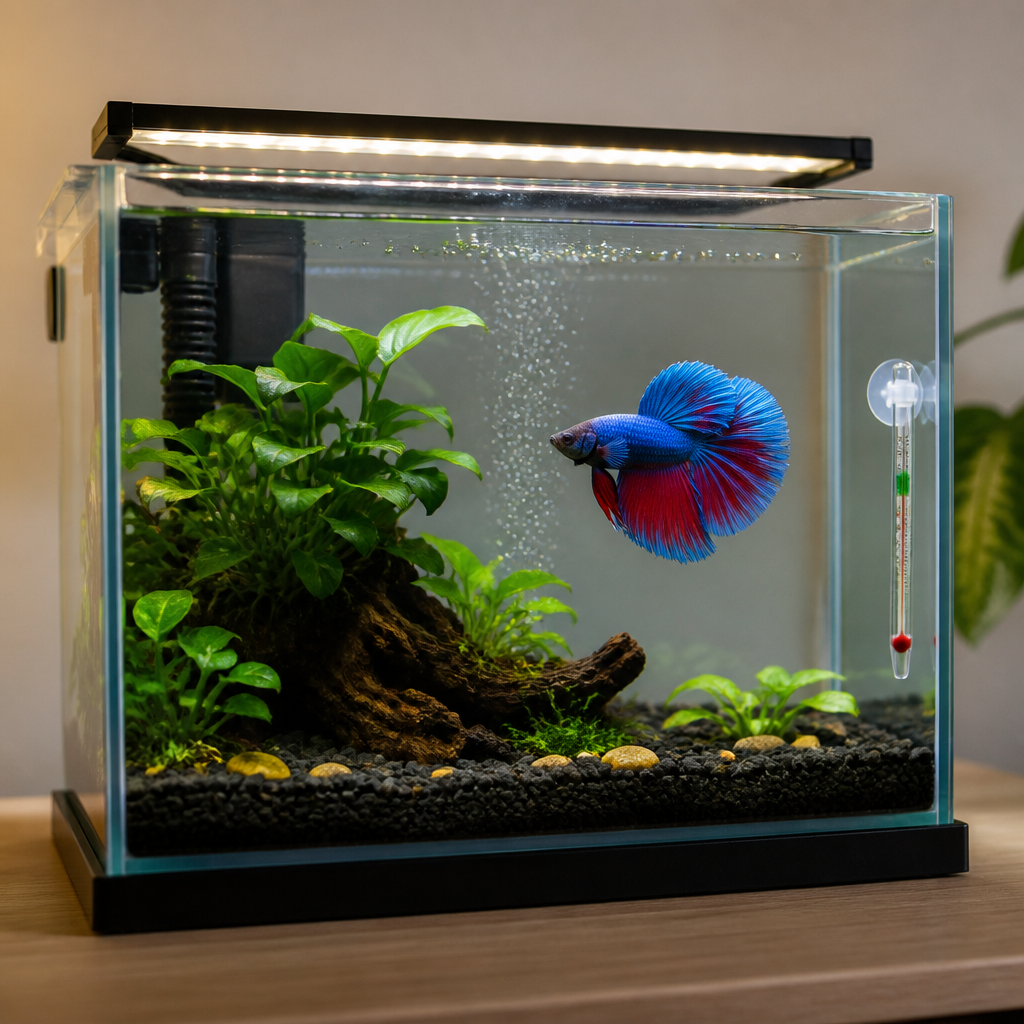
Most betta fish in Australia die within their first year. Not because bettas are fragile, but because they are misunderstood. They are sold in tiny cups, kept in unheated bowls, and fed whatever tropical flakes are on sale. The result? A fish that should live three to four years barely makes it past winter. If you have just bought a betta, or you are about to, this is the guide that will actually keep it alive. It covers everything relevant to betta fish care in Australia, including the one factor most overseas guides miss entirely: Australian room temperatures drop below the safe range for most of the year.
Table of Contents
- Quick Takeaways
- Understanding Betta Fish: Origin, Biology, and Why Australia Is Challenging
- Tank Setup: Size, Equipment, and What to Avoid
- Water Parameters: Temperature, pH, and Cycling
- Feeding Your Betta: Diet, Frequency, and Common Mistakes
- Tank Mates: Who Can Live With a Betta
- Common Diseases and How to Treat Them
- Enrichment and Behaviour: Keeping Your Betta Mentally Stimulated
- Buying a Betta in Australia: What to Look For
- Frequently Asked Questions
- References
Quick Takeaways
| Key Insight | Explanation |
|---|---|
| A heater is not optional in Australia | Most Australian homes drop below 24°C in autumn and winter. Cold water suppresses a betta's immune system and shortens its lifespan significantly. |
| Minimum tank size is 20 litres | Small tanks swing wildly in temperature and water quality. A 20-40 litre tank produces a noticeably more active and healthier fish than a nano setup. |
| Gentle filtration only | Bettas come from slow-moving water. Strong filter currents stress them, damage their fins, and cause exhaustion. A sponge filter is ideal. |
| Feed small, feed often, fast one day a week | Overfeeding is a leading cause of swim bladder problems and poor water quality. Feed once or twice daily, and skip one day per week to prevent bloating. |
| Males must never be housed together | Male bettas are highly territorial toward each other. Even brief visual contact causes chronic stress. Keep one male per tank, always. |
| Weekly water changes are non-negotiable | In small tanks, ammonia and nitrite accumulate fast. Replace 25-50% of tank water weekly, treating fresh tap water with a water conditioner first. |
| Never fill the tank to the very top | Bettas breathe air directly from the surface using their labyrinth organ. Blocking surface access can suffocate them, regardless of water oxygenation. |
Understanding Betta Fish: Origin, Biology, and Why Australia Is Challenging
Betta fish (Betta splendens), also known as Siamese fighting fish, are native to Thailand, Cambodia, Laos, and Vietnam. In the wild, they inhabit rice paddies, shallow pools, roadside ditches, and slow-moving streams. These are warm, often oxygen-poor environments, and that origin explains everything about how to keep them properly.
To survive in low-oxygen water, bettas evolved a specialised labyrinth organ, a suprabranchial chamber that allows them to breathe air directly from the water surface. They still have gills, but they use both systems simultaneously. This adaptation is often misread as evidence that bettas thrive in tiny, airless containers. They do not. It simply means they can survive briefly in poor conditions. Surviving is not the same as thriving.
The average lifespan of a well-kept betta is three to four years. Fish kept in unheated, unfiltered bowls rarely reach two. That gap is entirely preventable with the right setup.
The Australian-specific challenge is temperature. Unlike keepers in Southeast Asia or tropical parts of Queensland, most Australians in southern states and many in coastal cities experience room temperatures that regularly fall below 24°C from autumn through to late spring. Cold water does not just make bettas sluggish. It directly suppresses their immune system, making them susceptible to bacterial and fungal infections that a warm, stable tank would prevent entirely.
Tank Mates: Who Can Live With a Betta
The short answer is: bettas are perfectly happy alone, and solo keeping is always the simpler and safer choice. But compatible tank mates do exist, and a well-planned community tank can work well for bettas with calm temperaments.
The Comparison: Solo vs Community vs Sorority Setup
| Setup Type | Best For | Key Requirements |
|---|---|---|
| Solo male betta | Beginners, small tanks, fish with aggressive temperaments | Minimum 20L, heater, gentle filter, weekly water changes |
| Male betta in community tank | Experienced keepers wanting a community display | Minimum 40L, peaceful tank mates only (corydoras, small rasboras, otocinclus, snails), no fin-nippers or long-finned fish |
| Female betta sorority | Advanced keepers comfortable monitoring aggression hierarchies | Minimum 75L, groups of 5 or more, dense planting, multiple hiding spots, close monitoring |
Male bettas must never be housed together under any circumstances. Even brief visual contact causes chronic stress. In a community setting, avoid fin-nipping species like tiger barbs, avoid other brightly coloured long-finned fish that the betta may perceive as rivals, and avoid fast, active fish that will outcompete the betta at feeding time. Corydoras catfish, small rasboras, otocinclus, and mystery snails are among the most reliably compatible options.
Before combining a betta with tank mates, observe your individual fish. Some males are calm and indifferent to other species. Others are genuinely territorial toward anything that moves. Personality varies, and the tank mates that work for one keeper's betta may not work for another's.
Common Diseases and How to Treat Them
Most betta diseases are preventable with stable water conditions, appropriate temperature, and a good diet. When disease does appear, catching it early makes a significant difference to outcomes.
Fin Rot
Fin rot is the most common betta ailment, and it is almost always caused by poor water quality. It appears as fraying, discolouration, or erosion of the fin edges, progressing inward if untreated. The first line of treatment is improving water conditions: increase water change frequency, check temperature, and test for ammonia and nitrite spikes. In moderate to severe cases, treat with an aquarium-safe antibacterial medication. The fins will regrow in a clean, stable environment once the underlying cause is resolved.
Ich (White Spot Disease)
Ich appears as tiny white spots on fins and body, resembling grains of salt. It is caused by a parasitic protozoan and is extremely contagious within a tank. To treat ich, gradually raise the water temperature to accelerate the parasite's life cycle, making it more vulnerable to treatment, and use an aquarium-safe ich medication. Maintain clean conditions throughout treatment. Ich is often introduced via new fish or plants that were not properly quarantined.
Bloating and Swim Bladder Problems
A betta that floats sideways, struggles to stay upright, or cannot reach the surface properly may have a swim bladder issue. Overfeeding is the primary cause. Fast the fish for two to three days, then offer a single shelled, blanched pea to assist digestion. Prevent recurrence by feeding smaller portions and observing the one-day-per-week fasting routine.
Velvet
Velvet is a parasitic infection that produces a fine, gold or rust-coloured dust on the fish's body. It is easy to miss in early stages. Shining a torch or flashlight at a low angle across the fish will reveal the metallic sheen if velvet is present. Treat with a copper-based aquarium medication and reduce light levels during treatment, as the parasite relies on light for part of its life cycle.
Enrichment and Behaviour: Keeping Your Betta Mentally Stimulated
Bettas are curious, observant fish. A bare tank with nothing to investigate produces a lethargic, dull-coloured fish. Enrichment is not a luxury, it is part of basic care.
A well-planted tank with multiple levels of vegetation, broad-leafed resting plants near the surface, and structures to swim through or investigate keeps a betta actively engaged throughout the day. Rearranging decor occasionally also resets the betta's environment, encouraging exploration.
Brief mirror sessions outside the glass can stimulate the natural fin-flaring display response, providing exercise and mental engagement. Limit this to a few minutes per day. Prolonged mirror sessions cause stress, not enrichment.
Bubble nests are a healthy behaviour in male bettas, a cluster of air bubbles at the water surface where eggs would be deposited in breeding. A betta building bubble nests regularly is a reliable sign of good health and a comfortable environment. Do not confuse bubble nest building with surface gasping, which signals poor water oxygenation.
A consistent feeding schedule also produces noticeable behavioural responses. Bettas learn routines and will approach the feeding area in anticipation. This kind of regular interaction builds a genuine relationship between keeper and fish that makes betta keeping genuinely rewarding.
Buying a Betta in Australia: What to Look For
The quality of a betta at the point of sale varies enormously. Knowing what to look for before you buy will save you from inheriting a fish that is already sick or stressed.
A healthy betta displays vibrant colouration, holds its fins erect, and responds actively to your presence at the glass. Fins should be intact with no fraying, clamping, or white edges. The body should be full and symmetrical, with no visible lumps, pinecone-like raised scales (a sign of dropsy), or fuzzy patches. Avoid fish sitting motionless at the bottom or gasping at the surface.
Check the water in the container or tank where the fish is being held. Cloudy water, dead tank mates, or strong ammonia smell are warning signs that the fish has been kept in poor conditions. A fish from a dirty cup or crowded tank may already be carrying disease that will not present until you get it home.
In Australia, bettas are available through aquarium specialty stores, pet chain stores, and online platforms including MateLoop's aquatic pets section, where you can browse listings from breeders and private sellers, compare prices, and find live plants and aquarium supplies to complete your setup. Buying from a knowledgeable breeder often gives you a healthier fish and access to specific colour forms, tail types, and lineages that chain stores simply do not stock.
When you bring a new betta home, float the bag in the tank for 15-20 minutes to equalise temperature before releasing the fish. Do not feed for the first 12 hours. Allow the fish a day or two to settle before doing anything that might add additional stress.
Frequently Asked Questions
Do betta fish need a heater in Australia?
Yes, in almost all parts of Australia. Bettas require water temperatures between 24°C and 28°C. In autumn and winter, most Australian rooms drop below this range, meaning a small submersible heater and thermostat is essential for most of the year, not just in cold climates. Even in Queensland, cooler nights can drop tank temperatures enough to cause immune suppression over time.
What is the minimum tank size for a betta fish in Australia?
The absolute minimum is 20 litres for a single betta, but 35-40 litres produces a noticeably healthier and more active fish. Smaller tanks are chemically unstable, temperature-volatile, and require far more frequent maintenance to keep water quality safe. A larger tank is genuinely easier to keep stable, not harder.
Can I keep two male betta fish together?
No. Male bettas are highly territorial toward each other and must never be housed together. Even keeping two males in tanks placed next to each other causes stress from visual contact alone. If you want multiple bettas, keep them in separate tanks, or consider a female sorority in a large, heavily planted tank if you have advanced fish-keeping experience.
How often should I change the water in a betta tank?
Replace 25-50% of the water weekly, using a gravel vacuum to remove waste from the substrate during each change. Always treat fresh tap water with a dechlorinator before adding it to the tank, and match the temperature of new water to the existing tank water. In smaller tanks under 20 litres, more frequent partial changes may be necessary to keep ammonia and nitrite at zero.
What should I feed my betta fish?
Feed a high-quality betta-specific pellet as the staple diet, supplemented two to three times per week with frozen or live foods such as bloodworms, brine shrimp, or daphnia. Feed once or twice daily, offering only what the fish can consume within two minutes, and remove uneaten food promptly. Fast your betta for one day per week to prevent swim bladder problems and bloating.
Why is my betta fish building bubbles at the surface?
A male betta building a bubble nest at the water surface is displaying a natural and healthy behaviour. It indicates the fish feels comfortable in its environment and is in good health. It does not mean your betta is lonely or wants a mate. Simply maintain the stable, clean conditions that produced the behaviour and enjoy it as a positive sign.
Where can I buy a betta fish or aquarium supplies in Australia?
Bettas and aquarium supplies are available from specialty fish stores, pet chain retailers, and online through platforms like MateLoop, which connects Australian buyers with breeders, private sellers, and aquarium supply listings in one place. MateLoop also lists live aquatic plants, which are ideal for building a naturalistic betta tank environment.
If you keep bettas in Australia, we'd love to hear your setup story. Share your tank size, your heater brand, or the tank mates that actually worked for your fish in the comments below.
We would love your feedback and any insights you would share with others. What perspective would you add?
References
- Australian betta fish care guide covering temperature, tank size, and feeding requirements specific to Australian conditions
- Betta fish care sheet from an Australian aquarium retailer covering water parameters, diet, and tank mate compatibility
- Betta fish keeping guide from an Australian pet retail chain covering pH, temperature, feeding frequency, and compatible tank mates
- Veterinary-reviewed betta fish care sheet covering water parameters, equipment, feeding schedules, and health maintenance routines
- Betta fish care guide covering native habitat, lifespan, temperature requirements, filtration, and community tank guidelines
General pet care information for Australia. Always follow your veterinarian’s advice for your individual pet.