
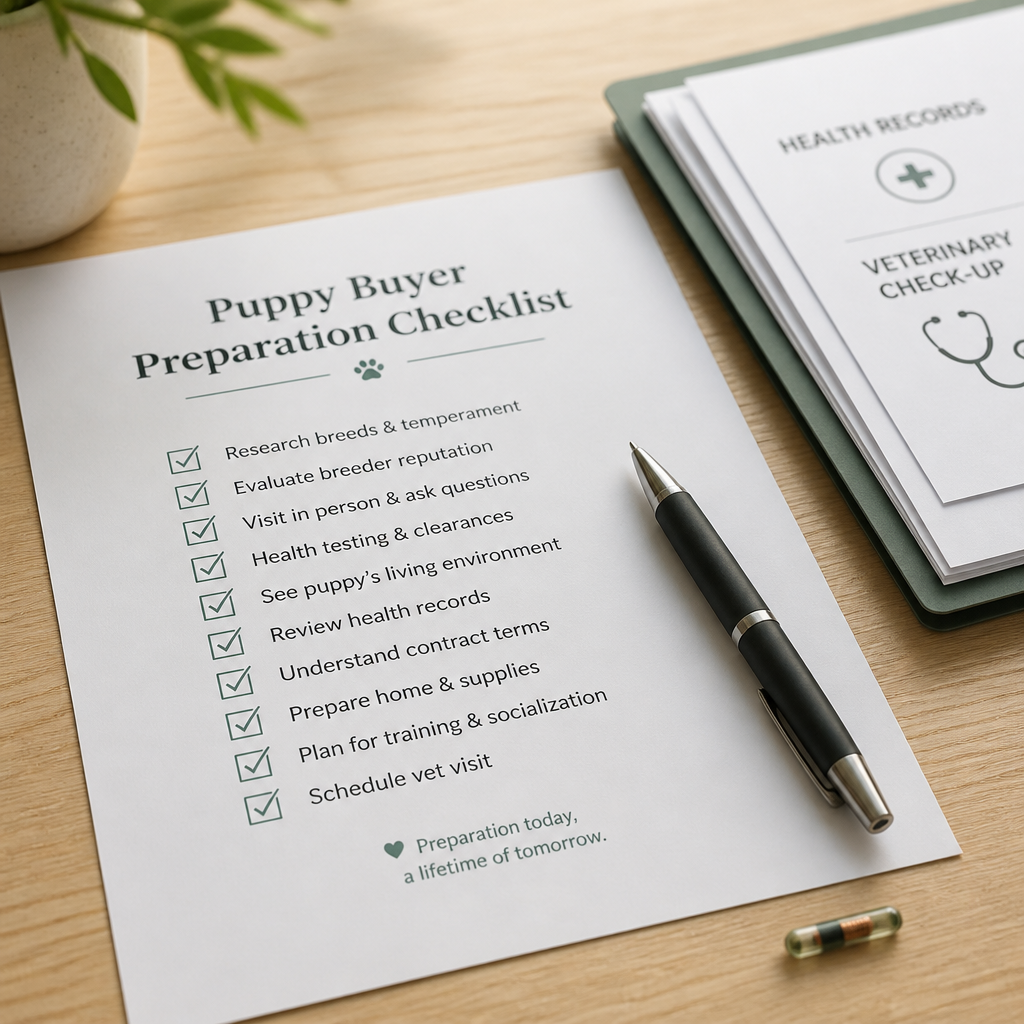
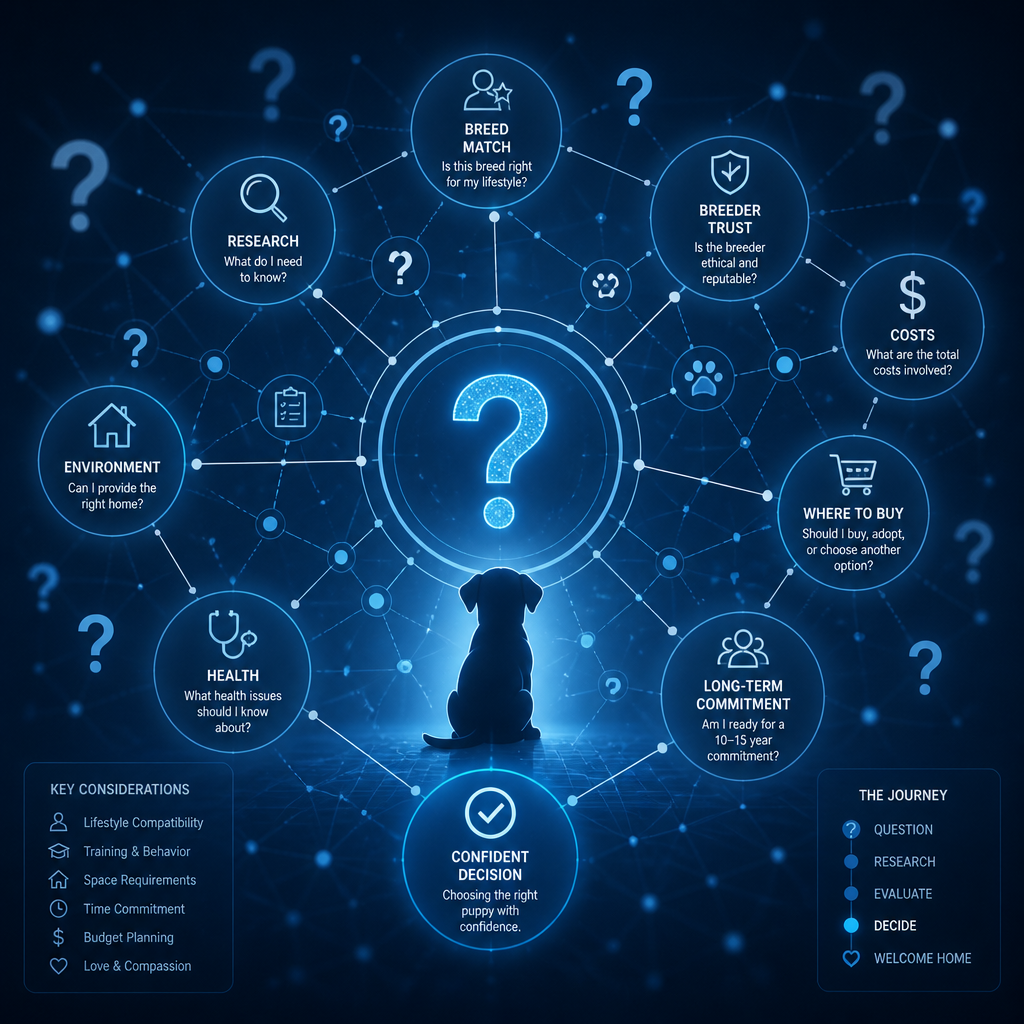
Most Australians who end up with a sick puppy, a scammed deposit, or a dog that simply doesn't fit their life will tell you the same thing: they didn't ask enough questions before handing over their money. If you're planning to buy a puppy in Australia, the questions you ask before you commit are more important than any amount of time spent browsing listings. This guide gives you exactly what to ask, why each question matters, and what a red flag answer looks like, so you can walk away informed rather than regretful.
Table of Contents
- Quick Takeaways
- Why Asking Questions Protects You
- The 10 Questions Every Buyer Must Ask
- How to Read a Breeder: Comparing Your Options
- Puppy Checklist Australia: What to Verify on the Day
- Where to Find Puppies and How MateLoop Helps
- Frequently Asked Questions
- References
Quick Takeaways
Key Insight | Explanation |
|---|---|
Never buy before 8 weeks | In Australia, puppies must not leave their mother before 8 weeks of age. Responsible breeders hold them until at least 8 weeks, and ideally 10 weeks. |
Microchipping is law in most states | In most Australian states and territories, it is illegal to sell a puppy without a microchip. Confirm the chip number before any money changes hands. |
Always visit in person, at their premises | A breeder who refuses a home visit or offers to deliver the puppy is a serious red flag. You should always see where the puppy was born and meet the mother. |
A registration number is not optional | Most Australian states require all breeders and sellers to hold a valid registration number. Ask for it and verify it with your local council or state authority. |
Health paperwork must be in writing | Verbal assurances are worthless. Request all vaccination records, worming schedules, and health screening results as physical or digital documents. |
A signed contract protects both sides | A legitimate breeder will insist on a purchase contract. If they don't offer one, that should make you pause. |
Breed-specific health tests matter | Some breeds carry hereditary conditions. Ask whether the parents have been screened. For example, Dalmatians should have hearing tests before breeding. |
Why Asking Questions Protects You
Buying a puppy is one of the largest lifestyle commitments most Australians make. A dog can be your companion for 14 years or more. The problem is that the excitement of a fluffy face at a first visit has a way of overriding the sensible questions that should have been asked over the phone, before you ever walked through the door.
Irresponsible breeders and outright scammers count on that emotional override. They price puppies attractively, post appealing photos on social media, and pressure buyers into fast decisions. The antidote is a prepared list of questions that you ask before you visit, so your decision-making is based on facts rather than feelings in the moment.
In practice, every question on this list serves a double purpose: it gets you useful information, and it tells you something about the person you are dealing with. A responsible breeder will answer every one of these questions without hesitation. They will welcome them. A bad actor will dodge, delay, or get defensive. That reaction is itself the answer you need.
A responsible breeder will be happy to answer your questions and will provide you with information on how to care for the puppy. Hesitation or evasion is a warning sign, not a personality quirk.
The 10 Questions Every Buyer Must Ask
1. How old is the puppy right now, and when can I take them home?
Ask this first, because the answer immediately tells you whether you are dealing with someone who follows the law. A puppy must not leave their mother before 8 weeks of age. Most responsible breeders will hold puppies until at least 10 weeks. If the breeder is pushing to place puppies at 5 or 6 weeks, stop the conversation there. Early separation causes lasting behavioural and health problems that no amount of training can fully undo.
Cross-check the age given against the birth date on any documentation provided. It is a simple step that catches people who misrepresent age to move puppies faster.
2. Is the puppy microchipped, and can I see the microchip number?
Microchipping is a legal requirement in most Australian states and territories before a puppy can be sold. A breeder who hands you a puppy without a chip is likely operating outside the law. Get the chip number in writing and verify it against the puppy's documentation. When you take ownership, you will need to transfer the registration into your name with your local council.
3. What vaccinations has the puppy received, and what is still outstanding?
By 8 to 9 weeks of age, a responsibly bred puppy should have received their first vaccination covering distemper, adenovirus (hepatitis), parainfluenza, and parvovirus. Kennel cough vaccination is also common at this stage. Ask to see the vaccination certificate issued by the vet, not a hand-written note from the breeder. Understand what boosters are still required and factor that cost into your planning.
4. Has the puppy been wormed, and what is the schedule?
Worming should be routine from a very young age. A responsible breeder will have a documented worming schedule and will tell you exactly what product was used and when the next treatment is due. Do not accept "yes, they've been wormed" without specifics. Request written records so your vet has an accurate baseline.
5. Can I visit the puppies at your home, and can I meet the mother?
This is the question that separates genuine breeders from puppy mills and middlemen. A legitimate breeder will always welcome a home visit. You should see where the puppies have been living, assess whether the environment is clean and stimulating, and meet the mother dog. The mother's temperament gives you one of the best predictors of what your puppy will be like as an adult.
If the seller hesitates, offers to meet you in a car park, or proposes delivery, treat it as a hard stop. No legitimate reason exists for a responsible breeder to prevent you from visiting their premises.
Pro tip: Ask to meet the father dog as well. If the sire is owned by a different breeder, ask for contact details so you can verify his health records independently.
6. Can I see all the puppy's documents before I commit to buying?
This includes the microchip registration, vaccination records, worming history, and, for purebred dogs, the pedigree certificate. A breeder who wants payment before showing you paperwork is one you should walk away from immediately. Documents should be available, complete, and legible at the time of your visit, not emailed to you afterwards once your deposit is locked in.
7. Will a purchase contract be signed?
A properly written puppy purchase contract protects both parties. It should outline the puppy's health status at the time of sale, any conditions on breeding or registration, and what happens if a hereditary condition is diagnosed shortly after purchase. A breeder who does not use a contract is either inexperienced or operating in a way they would prefer not to be documented. Neither is a position you want to buy from.
8. Have the parents been health-tested for breed-specific conditions?
Different breeds carry different genetic risks. Hip and elbow scoring for larger breeds, eye testing for certain breeds prone to inherited eye disease, and hearing tests for Dalmatians are all examples of screening that responsible breeders carry out before breeding. Ask what tests were done, ask to see the results, and look up the breed's known health risks yourself before the visit so you know what to ask about.
9. Are you registered as a breeder, and what is your registration number?
Most Australian states and territories require anyone selling puppies to hold a valid breeder or seller registration number. Ask for it directly and write it down. You can verify it with your local state authority or council. A breeder who cannot provide this number where it is legally required is operating illegally, and any warranty or contract they offer is essentially unenforceable in practice.
Registration with a recognised breed association, such as a state canine council, is a separate but related credential worth asking about for purebred purchases. It signals the breeder has agreed to a code of ethics beyond the minimum legal standard.
10. Are you the actual breeder, or are you acting as an agent or reseller?
This question matters more than people realise. Some listings present a seller as the breeder when they are actually a reseller buying puppies wholesale from a puppy farm and marketing them as "home raised." If the person you are speaking to is not the person who raised the litter, you need to go back to source. Ask where the litter was whelped, who the actual breeder is, and request direct contact. If that request is refused, you should not proceed.
Pro tip: Search the breeder's name, phone number, and address separately. Puppy farmers and resellers often run multiple listings across different platforms under slightly different names. A simple search can expose patterns that a single listing hides.
How to Read a Breeder: Comparing Your Options
Not all puppy sources are equal. Understanding the difference helps you make a faster, more confident decision when you are evaluating a listing.
Source Type | What to Expect | Key Risk to Watch For |
|---|---|---|
Registered Breeder (State Canine Council affiliated) | Health testing, pedigree papers, purchase contract, happy to answer all 10 questions, will want to interview you as a buyer too | Waitlists are common; higher prices reflect genuine costs. Beware anyone claiming affiliation they cannot verify. |
Registered Hobby or Home Breeder (state registration only) | Fewer litters per year, often good socialisation, variable levels of health testing depending on the individual | Ask the same 10 questions. Registration number is still required. Quality varies more widely than with council-affiliated breeders. |
Rescue or Adoption (shelter, foster network) | Desexed, vaccinated, microchipped at adoption, behavioural assessment usually completed, adoption fee much lower than purchase price | Breed, age, and temperament are less predictable. History may be incomplete. Best approached with realistic expectations rather than specific breed requirements. |
A common mistake buyers make is assuming that a high price signals a responsible breeder. In practice, puppy farmers charge market rates too. The questions above are a more reliable filter than price alone.
Puppy Checklist Australia: What to Verify on the Day
Your puppy checklist Australia should include a set of things you check in person, separate from what you ask over the phone or online. Seeing is different from being told.
Observe the environment
The space where the puppies are kept should be clean, warm, and stimulating. Puppies raised in isolation, in outdoor kennels with no human interaction, or in cramped conditions will have socialisation deficits that take months to address. Look for puppies that approach you with curiosity rather than cowering in a corner.
Check the puppy physically
Eyes should be clear, not runny or crusty. The coat should be clean. The belly should not be distended, as a pot belly in a puppy can signal worm burden. Gums should be pink. If anything looks off, ask the breeder directly and, if their answer does not satisfy you, do not buy that puppy that day. Have your own vet examine any puppy before finalising the sale if you have any concerns at all.
Verify documents match the puppy
The microchip number in the paperwork must match the chip in the puppy. You can ask a vet to scan the chip during a pre-purchase health check. The vaccination certificate should be issued by a registered veterinary clinic, carry the vet's name and clinic details, and list the specific products administered. A handwritten note from the breeder is not a vaccination certificate.
Pro tip: Take a photo of every document before you leave. If a dispute arises later, having your own copies of what was provided at sale is essential.
Where to Find Puppies and How MateLoop Helps
Finding a trustworthy listing is the first hurdle, and where you search matters. Generic classifieds aggregate listings indiscriminately, meaning scam ads and legitimate breeders sit side by side with no meaningful distinction. That forces buyers to do more due diligence from a standing start.
MateLoop is built specifically for Australia's pet community. The platform connects buyers with dog breeders, sellers, and rescue organisations in one place, and it pairs those listings with the kind of educational content this article represents, so buyers arrive at a listing already knowing what questions to ask. If you are looking to buy a puppy in Australia, browsing a marketplace designed around responsible pet ownership changes the quality of the experience significantly compared to a general classifieds site.
MateLoop also supports adoption listings alongside purchase listings, which means if your breed research leads you to reconsider and explore adoption, that option is available in the same place. Rescues and foster networks list dogs for rehoming directly on the platform, often with detailed temperament notes that general classifieds do not provide.
Frequently Asked Questions
What is the minimum age a puppy can legally leave its mother in Australia?
In Australia, puppies must not be sold or rehomed before they are 8 weeks old. This applies across all states and territories. Most responsible breeders will keep puppies with their mother until at least 10 weeks to allow for better socialisation and immune development. Any seller trying to place puppies younger than 8 weeks is operating outside the law.
Is it legal to buy a puppy without a microchip in Australia?
In most Australian states and territories, it is illegal to sell a puppy that has not been microchipped. As a buyer, you should request the microchip number before completing any purchase, verify it matches the paperwork, and then transfer the registration to your name with your local council after the sale. If a seller cannot provide a microchip number, do not proceed.
How do I verify a breeder's registration number in Australia?
Ask the breeder for their registration number directly. You can then contact your state or territory's relevant authority (often the Department of Agriculture or local council) to confirm the number is current and valid. State canine council registrations can be verified through the relevant council's member directory. Never take a registration number at face value without checking it.
What should a puppy purchase contract include?
A good puppy purchase contract should state the puppy's date of birth, breed, microchip number, and health status at the time of sale. It should describe what vaccinations and worming have been completed, outline any breeding restrictions or desexing requirements, and specify what recourse the buyer has if a hereditary health condition is diagnosed within a reasonable period after purchase. Both parties should sign and keep a copy.
What breed-specific health tests should I ask about?
This depends entirely on the breed. Larger breeds often require hip and elbow scoring of the parents before breeding. Breeds prone to inherited eye conditions should have parents with current eye certificates. Dalmatians should have BAER hearing tests. Before you contact any breeder, research the specific health conditions associated with your chosen breed so you know exactly what to ask. Your vet or a breed club representative can help you identify what the key tests are.
Is it better to adopt or buy a puppy in Australia?
There is no universally correct answer, but adoption is seriously underconsidered by most buyers. Rescue dogs are typically microchipped, vaccinated, and desexed as part of the adoption process, and adoption fees are a fraction of purchase prices. The practical difference is that you have less control over breed, age, and history. If you have a specific breed requirement for lifestyle reasons, a registered breeder is the right path. If your priority is giving a dog a home and you are flexible on breed and age, adoption is often the more straightforward, lower-cost, and equally rewarding option.
What are the biggest red flags when buying a puppy online in Australia?
The most consistent red flags are: a seller who refuses a home visit or offers to deliver the puppy; no microchip number; puppies younger than 8 weeks being offered for sale; no documentation available; pressure to pay a deposit immediately; and no willingness to sign a purchase contract. If someone asks for a bank transfer to hold a puppy before you have met it in person at their home, treat that as a scam unless there is compelling, verifiable evidence to the contrary.
Have you recently been through the process of buying or adopting a puppy in Australia? Share what question you wish you had asked in the comments, because your experience might save someone else a costly mistake.
References
General pet care information for Australia. Always follow your veterinarian’s advice for your individual pet.